.jpg) x86 1U 19-inch rackmount computers with 3rd Gen Intel® Core™ Celeron CPU, 6 gigabit Ethernet ports, 12 isolated serial ports
x86 1U 19-inch rackmount computers with 3rd Gen Intel® Core™ Celeron CPU, 6 gigabit Ethernet ports, 12 isolated serial ports
The DA-681A Series x86-based rackmount embedded computers are designed for control, monitoring, data acquisition, and protocol conversion applications. With their high density and robust design, the DA-681A computers are suitable for industrial automation applications, such as power automation, transportation, oil and gas, and factory automation.
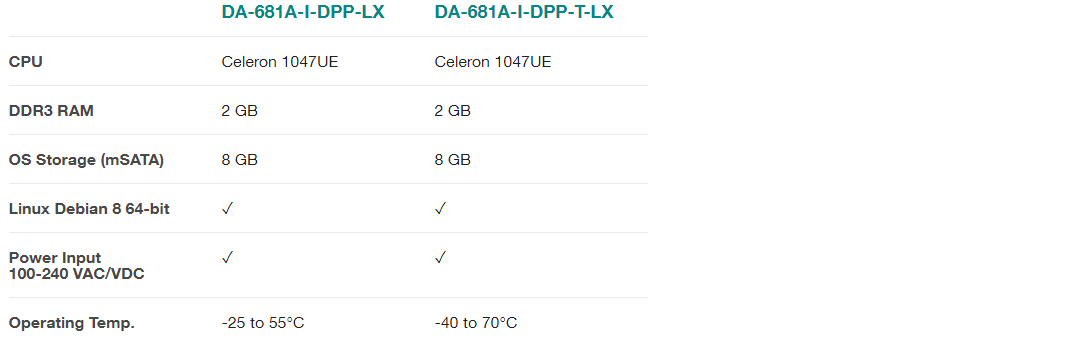
The DA-681A is based on the 3rd Gen Intel® Core™ Celeron 1047UE 1.4 GHz CPU and HM65 chipset, which supports standard x86, 1 x VGA, 4 x USB, 6 Gigabit LAN ports, 2 RS/232/422/485 3-in-1 serial ports, and 10 RS-485 (RS-422 by CV) ports. The DA-681A has a mini PCIe slot for mSATA and comes with Linux preinstalled; Windows 7 Embedded is also supported by a CTOS (Configuration To Order Service) process. Another plus is that the serial ports come with 2 kV digital galvanic isolation protection to guarantee communication reliability in harsh industrial environments. In addition, the state-of-art IEC 61850-3, IEEE 1613, and IEC 60255 compliance all-in-one design provides rich interfaces, especially well-suited for power substation automation applications.
The DA-681A's Smart Recovery function minimizes downtime by making it easy to recover from operating system crashes. Engineers who are experts in a particular vertical market may not have enough computer domain knowledge to know how to fix the operating system problems. Moxa Smart Recovery™ is an automated BIOS-level recovery system tool that allows engineers to automatically trigger OS recovery to minimize downtime.
Moxa Proactive Monitoring is a small-footprint, resource-friendly, easy-to-use utility that allows users to track a number of system parameters. Users can view the current parameter values for these key parts by simply clicking on the icons corresponding to the parameters in the user interface. User-defined key part indicators (KPIs) are used to monitor the computer’s key parts. Visible and/or audio alerts are triggered automatically via relay and SNMP traps when these KPIs exceed their preset threshold values, making it extremely convenient for operators to avoid system downtime by setting up predictive maintenance tasks well in advance.